NY Mayor Bloomberg: “telecommuting is dumb”

Telecommuting CatAnd for once, I have to agree with New York City Mayor Michael Bloomberg.

Telecommuting IS “dumb.”  Working from home, for a larger corporation or governmental agency IS dumb.

Because here is what you forfeit over someone else: presence.  And immediacy.

If you’re nothing but a governmental drone and couldn’t care less about promotions or better working conditions or advanced pay — yes — stay the hell at home.

Those persons interested in promoting and advancement make themselves known to their ranking individuals and make plans for ascending the corporate or public sector platform.  They present an immediacy and a presence that otherwise cannot be provided by anything less.

Start thinking like a Manager if you want to promote.  Start thinking like an Upper Manager if you want to promote.  Start thinking like a CEO if that’s where you wish to be.

Because, in an upper position, what would you rather do: promote an individual who thinks like you and has chosen a similar career path — or choose someone who will be at odds with you from the moment they step into their office?

I think we all know the answer to that question.  it doesn’t require a brain scientist or a rocket surgeon to discern.

Which is why: telecommuting is dumb for those with ambition; it is, however, perfectly in keeping with those who have no ambition whatsoever.

BZ

P.S.
Oddly enough, new Yahoo CEO Marissa Mayer agrees with Bloomberg.  She recently presented a memo that “working from home” is UNproductive.  And because, YES, it IS all about presence and immediacy.

The only working from home Yahoo employees will be doing is looking for another job.

The company’s remote employees have until June to take a shower and come into the office, according to a company-wide mandate put out by Marissa Mayer, the Business Insider reports.

If they don’t like it, they are encouraged to leave, according to reports.

I completely concur.  Because either you are an automaton, a drone, or you are an actual human being.

The remote workers simply aren’t productive enough for Mayer’s liking, according to an anonymous insider, who added that the company itself is bloated with too much infrastructure and too many workers whose duties are unclear. Employees were able to effectively “hide” for far too long.

COMPLETELY concur.

Unless you’re your own Personal Entrepreneur, here’s what you do working from home:

– Get up late; sleep in; stay in pajamas or shorts and tank top; scratch your belly;
– Feed the baby, make breakfast, send the wife/husband off to work or a Social Security office;
– Watch some TV’;
– Check personal e-mails;
– Pay some bills if lucky;
– Watch the Today show;
– Delay checking work e-mails;
– Watch Judge Judy; Wendy Williams has a nice show today;
– Schedule the car for its service;
– Take an afternoon nap; check out websites for tomorrow’s weather;

Ad nauseum.

Eventually, after around 3:30 or so, it’s time to address some actual work issues.  However, by that time, you rationalize it’s close to quitting time and, after all, no one can truly see when you physically stop work at home.

Mayor Bloomberg is correct.

BZ


Daylight saving time should be abolished

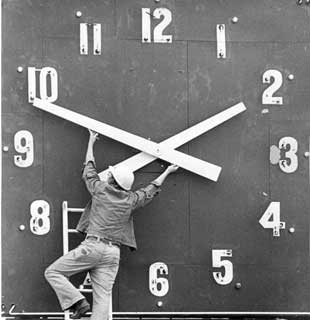
ClockDaylight Saving Time (United States) 2013 begins at 2:00 AM on Sunday, March 10 and ends at 2:00 AM on Sunday, November 3

Does it not seem to you that DST seems to extend itself farther and farther every year?

To what end?  And why?

First, a petition is circulating to kill DST or make it the new “now.”  From HuffPo:

On March 10, Americans will set their clocks forward an hour in the biannual ritual known as Daylight Saving Time (DST). But the hour of reckoning could be close at hand for DST, if some online petitioners get their way, that is.

A petition seeking to eliminate DST (or make it the year-round standard) has surfaced on the White House’s “We the People” crowdsourcing platform. The document, which needs 100,000 signatures to prompt a response from the West Wing, urges President Obama to eliminate the “archaic practice” of adjusting clocks twice a year.

Daylight Saving Time was standardized in the U.S. by the 1966 Uniform Time Act, according to National Geographic. That act has since been amended several times, most recently by the Energy Policy Act of 2005, which extended DST by one month.

The “We the People” petition claims that, while some industries still support DST, studies have shown the change is a health risk, leads to a loss in productivity and is “really annoying.”

I don’t know about the health issues, but I gladly cast DST into the “really annoying” category.  Because: we’re “saving daylight” for — what?

And one very interesting point I’d guess you’ve never realized:

Though participating areas of the country must switch their clocks on the same day, no federal law forces states to observe the time change, according to National Geographic. Arizona, for example, has not observed DST for decades.

Good for them, I say.  Independent thinkers who can make their own decisions.  Where are the other so-called “independent thinkers”?

Oh yes, that’s correct.  Pandering to DC for cash.  More Free Cheese.

The WashingtonCityPaper actually has a measured and logical view: get rid of DST.

For nearly 100 years, daylight saving time has been a pox on American sanity. It’s time for its long, dumb history to end.

Enough with changing our clocks (car, watch, bedside, kitchen); enough with the cutesy mnemonic devices (“spring forward—or backward?”); and enough with remembering things period (“is it this Saturday?”). Daylight saving time has been tried and tested all over the world for different reasons by many generations, and the only solid, incontrovertible fact to glean from this grand temporal experiment is that it’s a pain in the ass.

Yes!

Belief in DST’s energy-saving powers is often traced to a 1970s study from the Department of Transportation. A later review of that research by the National Bureau of Standards, however, found that the results were not significant. A more recent study by Yale professor Matthew Kotchen of energy consumption in Indiana (a state that formerly did not observe DST, and then observed it on a county-by-county basis) found that Indianans actually increased their energy use during daylight saving time by 2 percent: People might have turned on their lights less frequently, but they ran their air-conditioners more.

If the science behind DST’s supposed energy-saving powers is so inconclusive, why does this irritating pastime persist? Good question; let’s ask 7-Eleven. The convenience-store chain was the main source of funding behind a coalition supporting the extension of DST in 2005. Why? Because more sunlight in the summer meant more retail business. The National Golf Association also supported the extension, estimating that increased sunlight would increase golf revenues by $200 or $300 million, as detailed by Michael Downing in his 2005 book Spring Forward: The Annual Madness of Daylight Saving Time.

It’s stupid, it’s complicated, it yields much of nothing.

Time to become more simple and plain, I submit.

What say you?

BZ


Maxine Waters: 170 million jobs to be lost due to sequestration

From RealClearPolitics.com:

REP. MAXINE WATERS (D-CA): “We don’t need to be having something like sequestration that’s going to cause these jobs losses, over 170 million jobs that could be lost – and so he made it very clear he’s not opposed to cuts but cuts must be done over a long period of time and in a very planned way rather than this blunt cutting that will be done by sequestration.”

Video bearing this statement:

An impressive figure, to say the least.

But there’s a problem.

There are only 140 million jobs in the entire United States.

BZ

P.S.
Perhaps even more stupid (little shock to any of my readers, no doubt) but not as recent:


The supposed “end of retail” — ?

Vice President Joe Biden says that Americans are no longer worried about the economy:

“But all kidding aside, I think the American people have moved — Democrats, Republicans, independents.  They know that the possibilities for this country are immense.  They’re no longer traumatized by what was a traumatizing event, the great collapse in 2008.  They’re no longer worried, I think, about our economy being overwhelmed either by Europe writ large, the EU, or China somehow swallowing up every bit of innovation that exists in the world.  They’re no longer, I think, worried about our economy being overwhelmed beyond our shores.”

Americans are no longer worried about the economy?  Really?  You think that’s true?

I think that’s not just a fabrication, but a bald-faced LIE.

Retail is — on many levels — starting to become moribund.

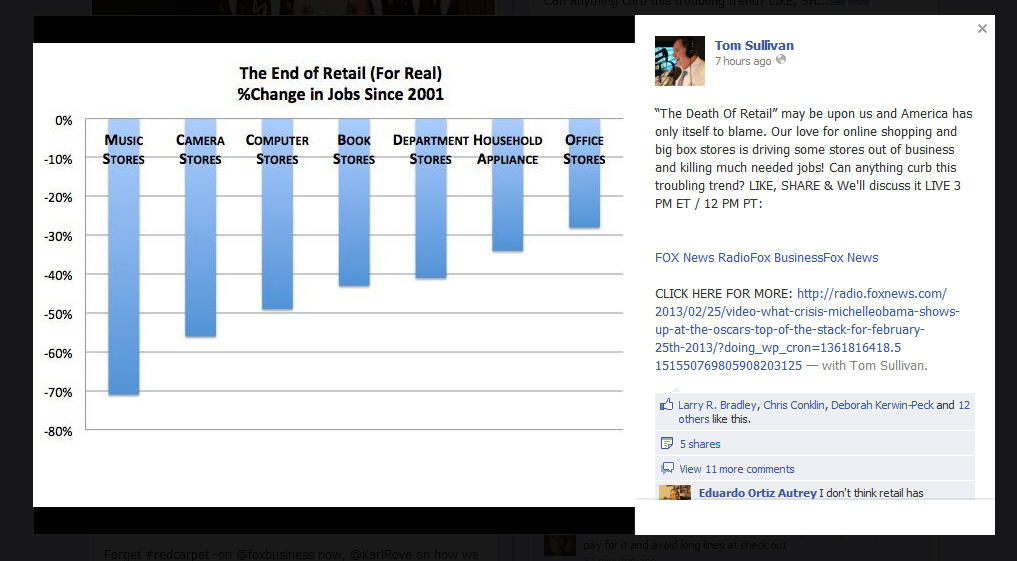
Check this graphic from TomSullivan.com:

Retail -- The End of Retail StoresYou can see that music stores are apparently the most greatly impacted with employee and store outlet loss, followed by camera and computer stores.

I’m sure you can see the results of retail outlet closures in your own community — no matter where you are, on the east coast, the west coast, north or south.

The retail paradigm is changing, and it is changing not unlike the replacement of the horse with the car, or the steam locomotive with the diesel-electric locomotive.

So-called Mega Malls are changing; so are regular malls.  Stores are closing.  Chain stores are closing.

You are responsible.  I am responsible.  And yet, I certainly very much miss my local Borders book stores.  They closed.  There are only two Barnes & Noble stores in Sacramento — the capital of Fornicalia — and both of them are incredibly inconvenient for me.  Yet, I go there, because that’s how I become aware of new books.

I can see them, I can hold them, I can smell them, I can read their covers, suss out their basic premise, and scan a few pages to see if I like the writing itself.

My Tower Records store closed.  Tower Books closed.  Virgin Records closed.  It was a HUGE store at Arden Fair Mall.

I step back: there was a small and wonderful music store in Grass Valley, on Mill Street, in the mid-1990s, where you could walk in and sit at a counter and ask to see a specific CD.  You could hold it in your hand, check out its cover, place the CD into a player and, with headphones donned, listen to the content.  If you liked it, you bought it.  I was generally the oldest bastard in the place, where the chicks were tattooed and pierced and dyed but here is where I found out about the groups Material, Bill Laswell, Bill Nelson, Deep Forest, Blue Man Group, and any number of artists who otherwise wouldn’t have been displayed on my musical radar screen.  My musical expanses were challenged and exploded.  I loved it.

But — moreover — what does the “end of retail” mean for younger people?  I expect: much.

From TheAtlantic.com:

We see a large and growing gap between unemployment and the employment-population ratio. There are numerous micro explanations here.

One possibility, however, is that the relatively weak growth in shopping center employment relative to retail sales since 2000 and especially recently is driving down overall teen employment levels.

However, because teenagers are especially suited to shopping center employment they are dropping out of the labor force in response. That is, the End of Retail is causing a permanent shift in teenage employment because there are no substitutes for retail jobs.

This is a true structural downturn because it means that the production function is changing such that the productivity of teenage labor cannot meet the reservation wage.

When that happens a factor of production simply goes out of use. It also implies that for a time the economic gains from productivity enhancements will be muted. E-commerce means more efficient shopping but because we are not repurposing teenage labor but losing it completely, the measured gains are less than they otherwise would be.

Retail work — for me, possibly for you — was essentially a Rite of Passage in the 60s and 70s.  You worked for a retail store and you learned how to deal with people and you learned how to work with a boss and you learned how to work with a time card and you learned how to show up at a specific time or you simply wouldn’t get paid.

You learned how to open a store, or you learned how to close a store.  You learned how to prep a store for the next day.  You cleaned up.  You mopped the floors.  Or you learned how to prep the register with cash for the coming day.  You learned how to make a night deposit.  You learned how to make change.  With no calculator except that of your brain.

I worked for the JC Penney store on Watt Avenue.  I knew 35mm photography.  I sold the greatest amount of cameras.  I helped my customers.  I cleaned their lenses, I told them how to change their ISO, I sold them SX70 cameras.  I worked in retail and I worked on a very basic and meager salary but with commission.  My commission was generally the greatest of everyone else, for the three months I worked there.

Those days — these days — are apparently dying.

Amazon and any number of .com websites are making it so.

Any thoughts of yours?  What are you seeing — if anything — in your community?

Where you live — is retail taking a hit?

BZ


Dale Earnhardt died, this day, 12 years ago

Dale-EarnhardtThe Intimidator, #3, died in his black Chevrolet on this day in 2001, at age 49.

Few people believed he could have died due to that seemingly-small collision.  However, he perished from a basilar skull fracture in Turn 4 of the final lap of the Daytona 500.

The longest-lasting result of Earnhardt’s death was the mandatory inclusion of the HANS device in all NASCAR vehicles.

The Intimidator is dead; long live The Intimidator.

BZ

Last interview here: