9-11: A Tribute

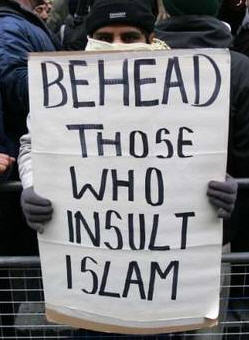
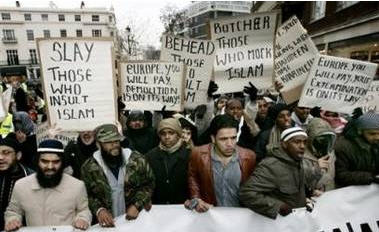
I’m going to take a bit of a different tack than most bloggers and the media likely will today. I shall not focus on the falling of the Towers or American patriotism; instead I shall display, in photos for all to see, how Islam portrays itself today — five years after our marked event.

Thank you, Steve.

These photos are from a London “Religion of Peace” protest. Witness for yourself the true thoughts and intentions of Islam:

Freedom: Go To Hell.

I would submit that the concepts of freedom and democracy are ideas wasted on those intent upon embracing Islam.

They deserve the kinds of governments and rulers they embrace.

I cannot say this with sufficient frequency: the sooner we locate and drill our own oil, the sooner we move from a petroleum-based economy, the sooner we can tell these ignorant religious bastards to simmer in their own swill and abandon them completely.

We are there for oil. Let no one tell you anything other. But we must protect our own interests or we will be living in the SM Stirling novel “Dies The Fire.”

God Bless America.

The last, best hope of this entire planet.

BZ

Blair Will Be Proven

How sad to see and hear that Tony Blair has given way to political pressure to step down prior to the end of his term.

Blair is no one’s Toady — not of the US, not of anyone.

He has consistently been looking out for the welfare of his country, though his countrymen and-women have not the capacity to see this for themselves. Londonistan has clearly had its influence.

In a recent interview, Mr. Blair said it would be remarkably stupid to ignore the threats made to Israel from Iran.

Please read the entire following:

Did you find Prime Minister Olmert different from when you met him last (in June)?

Obviously it’s been a very traumatic, difficult time. When you lead a country through a crisis like that, it’s a massive challenge. I found him extraordinarily focused and energetic and determined.

Did you give him any political advice?

He was more likely to be giving me political advice! What I did say was this. The important thing is for Israel to be always the country that is striving for peace but is sometimes forced into war. And that’s why it’s important that we got the resolution 1701, because that is a political framework within which the issues to do with Lebanon can be dealt with. And if we can, we should invigorate the peace process with the Palestinians.

Olmert has forgone the West Bank disengagement.

The important thing is to try and get a negotiated agreement because that in the end is the only way forward. Now, in Israel people will be very skeptical, not to say cynical as to whether it is possible at all. There is one major strategic question that has changed in the whole of the international community. People everywhere now see this global movement of extremism, they see Iran putting itself at the head of it, and there is a huge strategic interest that includes America, Europe, Israel and any Arab and Muslim countries that want a modern future – there is a huge strategic interest in making sure that that extremism doesn’t succeed.

Did the Lebanon war sharpen this consciousness?

Yes, I think it did, and though obviously, for obvious reasons because many innocent people died – many innocent Israelis, many innocent Lebanese – and the destruction of so much in Lebanon is terrible, of course. And so while the conflict was going on, it was very difficult for people to think in terms of anything other than stopping the conflict. But I think that there emerged from that a clearer notion of how this came about and how Iran and to an extent Syria are pulling the strings and ensuring that there is such conflict. And so I think there has been that greater clarity.

Greater clarity in your mind. But what makes you think in the minds of other European leaders?

Because I think amongst the leaders in Europe I think it is clear. Amongst the people in Europe and Western opinion there is a big battle to be won. I mean, I’m being just honest about this. And I think there is a desire not to face the fact that we are fighting a global struggle. There are all sorts of issues to do with America and whether people want to be associated with America. And I think there is sometimes a naivete about organizations like Hezbollah and the activities of Iran. I’m just being frank. I think there is a battle, and it is important that we take our case out and win that battle.And one part of winning the battle is making the case as to why Israel is entitled to its security and why it’s important to revitalize the Palestinian process.

How can Israel fend off the erosion of its legitimacy, the proposed indictments of Israeli officers — academic boycott in Europe and in UK in particular?

The two things are: To give people a real sense of strategic clarity about the threat that we face, and secondly to be the people who are striving to revive the Palestinian process. We may not succeed, but we should always strive.

With the recent arrests of suspected terrorists in the UK. These are people who grew up in the UK, in the welfare state, with no experience of any form of oppression or occupation. Did you ask yourselves what went wrong, what you did wrong?

Well, they become like that. It’s not necessarily what have we done wrong, because part of the problem of what you have in Western opinion is that Western opinion always wants to believe that it’s our fault and these people want to have a sort of, you know, grievance culture that they visit upon us and say it’s our fault.

And so we have a young British- born man of Pakistani origin sitting in front of a television screen saying “I will go and kill innocent people because of the oppression of Muslims,” when he has been brought up in a country that has given him complete religious freedom and full democratic rights and actually a very good job and standard of living. Now, that warped mind has grown out of a global movement based on a perversion of Islam which we have to confront, and we have to confront it globally.

And as I said recently in my L.A. speech, the first way to win a battle is to realize you’re in a battle. That’s part of the trouble: We don’t yet really understand this is a global movement and it requires a global strategy to beat it.

One other point – you can’t beat it simply by security or military means. This is an ideological battle. It’s got to be taken out to the enemy. And that’s why I say it’s important for us always to be the ones who have got a political strategy running alongside the military strategy. We should never, ever, whatever the technical difficulties, let the political strategy fall away.

We in our paper see your political difficulties and the battle of ideology as very closely linked. We have witnessed with a certain amount of sorrow your inability to inculcate this awareness in your own public opinion and among Western European opinion.

Yeah, but you know in the end sometimes it takes people a long time to wake up. And sometimes these struggles go over a whole generation, almost. It’s less important what my position is – but as you say rightly, I expect it indicates that we’ve got a big job to do.

But I think that underneath opinion is changing. On the surface I agree at the moment, no, it isn’t. But underneath people are beginning to see it change. Now my own view is that if we were able to revive the Palestinian process that would be a huge part of persuading opinion that the one issue where even quite moderate Muslims just feel frustration and anger – that we were dealing with it now.

I know from the Israeli point of view how frustrating it is to be told, you know, this is an issue that in the interest of the world has got to be solved — and you worry in Israel that maybe our interests get sacrificed in the course of finding a solution. I hope that I’ve done enough to prove that I will never sacrifice the security of Israel in that way. But I do genuinely believe that our job has got to be to build that alliance of moderation and empower the moderate Muslims and Arab voices.

We are concerned that even you cannot evoke from the Palestinian side – now that the Hamas has won power and Abu Mazen is merely a figurehead, having lost the election to them – even you can’t evoke a negotiating partner, just when an Israeli government, however bruised and battered, is ready to relinquish the vast bulk of the territories.

That’s absolutely right and I understand that. One of the things I’ve been discussing here – because this has been a very strong sentiment of mine for a long time – is that what should have happened on disengagement from Gaza is this: Everyone should have come into Gaza, built a strong institutional capability and governing capacity, with the economic reconstruction, and then say, ‘right – the disengagement from Gaza is the beginning, now let’s move to the next stage.’ I’m sure that is what should have happened. And it didn’t.

And the fact that it didn’t means that there is in my view a need for the international community to support in a far stronger and more effective way capacity on the Palestinian side. Otherwise there are two alternatives: What happens is that either we try to reinvigorate the process but it never really happens.

You agree to documents but they’re never really operationalized; or alternatively what happens is that – and I think this is a reason why it is very much in the strategic interests of Israel to try to make progress – is that you can end up with a sort of semi-state on the Palestinian state, full of militias and gangs and trouble.

But the Hamas government rejects the conditions of the Quartet, despite the economic and diplomatic boycott and military pressure?

Yes, well I think there is a lot of pressure coming now from the Palestinian people. This refusal to accept at least the basis of the Quartet principles is holding back the Palestinian people. And after all, how can we possibly negotiate with a government about a two-state solution if they don’t accept the existence of the other state?

Is it pie-in-the-sky to see the beefed-up UNIFIL as something of a precedent for involvement in the Palestinian question later?

Only in this way: Not that you’d replicate that type of force or anything like that, but I think that it does indicate that sometimes what happens is not that moderates don’t want to do the right thing – but that they don’t have the capacity to do it. I am quite sure that Prime Minister Siniora never wanted a situation where Resolution 1559 was never implemented. He wasn’t able to do it. Interestingly, with Resolution 1701 he may be able to do it. I think in the same way we can transfer the analogy to this extent: That’s why you need real international support on the Palestinian side. I think that is in the interest of the Palestinians and of the Israelis as well. Obviously these are things we’ll now discuss, because I think you’ll find now a great churn of activity but we need to make sure that out of it comes something that is applicable.

Regarding Iran, do you agree with the comparisons to the 1930s that we often read about?

When you have the President of a country as powerful as Iran say those things, it may be very foolish of us to assume he doesn’t mean them. And when he’s also trying to acquire a nuclear weapon, then I think the warning signs are pretty clear… I think for a president of a country to say they want to wipe another country off the face of the earth and at the same time he’s trying to acquire a nuclear weapons capability – if we don’t get worried about that, future historians will raise a few questions about us and about our judgment.

________________________

UK’s Tony Blair “gets it.”

Do we?

BZ

The Day My Music Died: 09-07-2003

WARREN WILLIAM ZEVON:
01-24-1947 to 09-07-2003

I remember I came to the site a few days later and gaped with astonishment. The site had vanished and in its place was a photo, his full name, and a birth date and death date. And these three words: “Enjoy every sandwich.”

For some reason, this death became my preoccupation for weeks thereafter. Was it because my mother had died in May of 2002, and my father had experienced his own life and death medical emergency in 2003? Or was there more?

Warren Zevon was me. He was me and I was him. I was in my own little world and I simply assumed he would consistently be in my world as well. Except, of course, that reality tends to get in the way of the best laid plans. Years of comfort and assumption.

Warren was a few years older than me. But not so much older that I could not relate to what he said and when he said it.

Persons have said that I have a black and grim sense of humor — with an emphasis on the cynical, sarcastic and egregious.

In this vein, Warren went to his dentist in August of 2002 and, as an aside, happened to complain of a shortage of breath while exercising — “I was working out more than Vin Diesel,” he said. One medical referral later, Warren was handed a literal sentence of death. The same day.

At 56, Warren was diagnosed with mesothelioma, a disease that late-night talk show lawyers attribute to asbestos inhalation and related problems. The cancer is considered rare and, generally, inoperable. So it was with his condition.

Originally given a mere three months to live, Warren Zevon shoved this estimate aside and collected his family and friends about him, determined to produce one final and complete album.
And that he did — then passed away, in his sleep, almost a year to the precise day that he was diagnosed.

Warren is me and I am him. He has passed, dead from a horrible disease. Something I can acquire and have fought. He brings to me my mortality. My generation of entertainers are dying. I am mortal. I am finite. I don’t want to think about this. And yet I must because my favorite musical artist is now dead.

Does that not sound cheap and shallow? Who cares about what music I enjoy? — Except that, having been in radio my late teens and early 20s as an on-air DJ, Music Director, Program Director, Promotions Director and actual Station Manager, my entire life at one time revolved around music and Warren clearly intrigued me from the beginning. For those keeping track, I worked for WWSU and WING in Ohio, then to KERS, KEG in Sacramento, KOBO in Yuba City, a brief time for KROY/KNDE (Wonder Rabbit!) and finally KFBK-AM and KFBK-FM. I worked production for KNBR in San Francisco for a time, then worked for a local audio production facility. I did voice-overs, narration, and corporate audios and videos.

In the meantime, Warren wrote and sang about death, guns, special ops, politics, animals, the Soviets, death, almost anything but love — and, then, okay, sometimes about love — but sparingly. And when his love songs came, they came disguised, heartfelt and then, later, incredibly effective in their simplicity.

You needed to analyze his words, read his lyrics. Take the time to unearth the meanings. I readily admit: I took Warren Zevon for granted. Certainly, I purchased every album. I initially thought many were weak and poorly produced. I questioned his moving from one label to another. Was it because no one wanted to have anything to do with his music? He had, after all, moved from Asylum to Elektra, to Asylum, to Virgin, to Giant and then to Artemis. Could he not find a “home” because of his poor recordings? Who had ever heard of the labels “Giant” or of “Artemis?”

Except that: one of his two finest recordings, from the album “Mutineer” (what I then considered to absolutely be his weakest recent work) would be the lilting “Similar to Rain” and maybe even “Mutineer” itself. I thought Piano Fighter to be a throwaway, and many of his other songs, until I gave them a chance. That’s all I had to do. Give them a chance.

And then Warren produced his final album, which won two February 2004 Grammies; one for Rock Performance by a Duo or Group With Vocals for “Disorder in the House,” with Warren and Bruce Springsteen, and won Best Contemporary Folk Album, for The Wind — which likely to this day has Warren turning in his grave because anything he ever produced would NEVER fit into something as lame as a “folk” album.

And yet, I never had a true appreciation for the agony, angst and struggles he experienced to complete his final album, The Wind. VH-1 filmed portions of the production of this CD, and produced a beautiful and gut-wrenching documentary of the event.

I am so glad I watched it once. And I am so not sure I can ever watch it again. At one point it shows a lost Warren Zevon having to be told by his best friend and session bass player, Jorge Calderon, how to time his singing to the music bed. Warren just couldn’t pick up the right timing signature. He was lost. Absolutely lost. And so was I. For him.

I write this through tears of confusion. Oh sure, I won’t soil the keyboard. But Warren was me and I am him. And another once-comfortable portion of my life is gone. Another one of those persons, unrecognized in Life, but finally recognized in Death.

He was me and I was him. Sarcastic, irreligious, fascinated with politics, war, death, black humor. And with some occasional glimpses of love.

Sometimes love is wet and cold;

Similar to rain, just as hard to hold.

Love can make you sad and blue,

If you don’t watch out it’ll fall all over you.


Talk about irony. He was all about irony.

____________

I wrote this a week after Warren Zevon’s passing in 2003 where it was published in a trade magazine. I reprint it here, now, to commemorate his passing. I too, like Warren, seek to “enjoy every sandwich.”

It is said that Life is what occurs whilst you’re making other detailed plans.

I recognize that now.

I also recognize how swift is the passage of time and how very important it is to proffer more hugs, love more, see more sunsets, witness more sunrises, hold more hands, and see things through the eyes of a child.

Life is too short for bad beer, and saying “some day we’ll do that.”

No you won’t. Make plans now. Tell people you love them now. Expose your heart now. Step up. Step out.

If not you, then who? If not now, then when?

BZ

Requiescat in pace


A friend of mine passed away in an automobile accident. I received the phone call late last night. He was a fan of Stevie Ray Vaughn. He would like this:

From SRV’s “The Sky Is Crying” album:

Life By The Drop
Hello there, my old friend,
Not so long ago it was ’till the end
We played outside in the pouring rain,
On our way up the road we started over again.
You’re livin’ a dream,
Whoa, you on top
My mind is achin’,
Lord it won’t stop
That’s how it happens,
Livin’ life by the drop.
Up and down that road in our worn out shoes,
Talkin’ ’bout good things and singin’ the blues
You went your way, I stayed behind
We both knew it was just a matter of time
You’re livin’ a dream,
Whoa, you on top
My mind is achin’,
Lord it won’t stop
That’s how it happens,
Livin’ life by the drop.
No wasted time, we’re alive today
Churnin’ up the past, there’s no easier way
Time’s been between us, a means to an end
God it’s good to be here walkin’ together my friend.
You’re livin’ a dream,
Whoa, you on top
My mind is achin’,
Lord it won’t stop
That’s how it happens,
Livin’ life by the drop.
That’s how it happens, livin’ life by the drop
That’s how it happens, livin’ life by the drop.

________________________

Peace be with you, Chuck.

BZ

_________________

I am away on my final session of school in San Diego. I shall return on Saturday. Take care and tell everyone you love how you feel about them: today.

Steve On The Barbie


Steve Irwin, age 44, is dead after the spike from a stingray pierced the left front of his chest and into his heart. He leaves behind his wife Terri Irwin, 42, and two children, Bindi Sue (8) and Robert Clarence (3).

Of all radically ironic things, to be killed by the barb of a stingray — surely a manner of death I had never even remotely imagined for Steve Irwin. I envisioned him succumbing to horrible wounds from, say, a crocodile that managed to catch him unawares; I envisioned him being the victim of the bite from a Black Mamba; but never aquatically.

Some people will likely think, say or write that Irwin got nothing more than what was due him for his history of attempting to “humanize” wild animals, not unlike Timothy Treadwell, the so-called Grizzly Man who was killed at age 46 with his girlfriend, Amie Huguenard, 37, when they were both attacked and partially eaten by a brown bear in Alaska’s Katmai National Park on October 5th of 2003. In my post, Grizzly Man: Today’s Allegory, I wrote that “Treadwell tried to ‘understand’ the bears — he wanted to sit down and break croissants and have a nice latte with them. They tolerated him for a while or remained indifferent at best. Until one bear, one day, simply got hungry, and the food chain was complete.”

Steve Irwin did not take the “humanization” route; to be sure, he was perceived many times to be the fool, jumping on the backs of crocodiles — even causing much worldwide consternation when he held his then one-month-old baby, Robert, while feeding a snapping crocodile at his Australian zoo in 2004. His greatest fault may have been the comfort and confidence he felt around wild animals.

Certainly he pushed the envelope and we all, I suppose, knew that one day he would die at the hands (or barb!) of an animal. I guess he knew that as well — just not suspecting the manner of his final exit. He was an environmentalist and, moreover, put his money into his Australia Zoo in Beerwah on Queensland’s Sunshine Coast.

Watching Steve Irwin was not unlike watching a NASCAR race — knowing or thinking that something bad may happen — a guilty thrill. His episode detailing the ten most venomous snakes in Australia — and he picked them up by the tail? You knew he would be bitten, and he was bitten by snakes on TV (though none were poisonous).

Steve also blazed the TV trail with regard to others coming after him. Certainly, Jack Hanna was the “first” person who brought animals up and close to TV audiences but it was some time before he acquired his own show. Irwin also spawned Jeff Corwin and the other guy (whose name escapes me!) who wrangles snakes. Even the Dog Whisperer, Cesar Millan, owes his place on TV to Steve Irwin.

As my fiance wrote:

Well, he saw an opportunity and ran with it. He was raised by his dad to not have total respect for nature; thought he knew all about animal behavior, but the thing is, guess what? Just like humans are generally the same, we all have our idiosyncrasies — same with animals. 99 times out of 100 animal behavior can be generally predicted, but you never really know what happened to that stingray last time something big swam over him. He may have had to fight for his life last time, and animals DO have a memory, so in terms of experience, not all stingrays act the same way.

We all knew Steve pushed and sometimes overloaded the envelope. It was why we watched.

But moreover, what about Terri and her two now-fatherless children? Steve should have factored his family into his life. But he was what he was. And Terri knew it, and bought into his life fully. She enabled his actions. Now the children shall not see their father any more. How sad.

Crikey.

BZ