
I do not believe, knowing what I do about the history of our shuttle system, that I would set foot in any of our current shuttles — not only as these airframes are old and tired, but because of the continuing culture of not only NASA but its numerous contractors, as illustrated by the deaths of fourteen of our finest astronauts — most recently the STS 107 mission on February 1st of 2003 wherein chunks of material insulation sloughing off the main propellant tank holed the shuttle Challenger and caused it to burn up in the atmosphere. All seven astronauts perished in, I can only assume, the horrible fires of Hell.
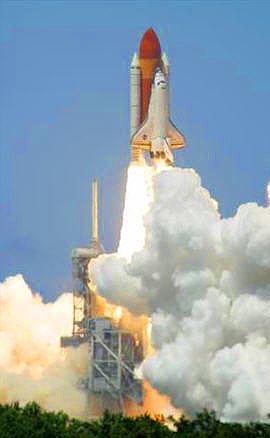
Now, Tuesday’s launch of Discovery occurred in fair skies:
CAPE CANAVERAL, Florida (Reuters) – The U.S. space shuttle Discovery roared off its Florida launch pad on Tuesday on a voyage to the International Space Station, a mission whose failure would likely ground the shuttle fleet permanently.
Discovery, carrying seven astronauts, lifted off from the seaside launch site at 2:38 p.m. EDT (1838 GMT) and soared into sunny skies, jettisoning its booster rockets about 2 and a half minutes into the flight. It reached orbit safely about 9 minutes after launch.
Not a bad beginning but, of course, there is more:
Up to six pieces of debris that could be foam insulation fell off Discovery’s troublesome external fuel tank minutes after liftoff Tuesday, a top NASA official said. Officials cautioned, however, that it was too soon to know whether the debris struck Discovery and that the pieces came off later than would normally endanger the shuttle.
Columbia’s demise in February 2003 was caused by foam insulation that peeled off 70 seconds after liftoff and struck its heat shield.
“About two minutes and 47 seconds give or take (after the Discovery launch), we saw three perhaps four pieces come off (the fuel tank),” said shuttle program manager Wayne Hale, adding that it was unclear whether it was foam or “something else.”
“We also saw another piece or two come off at about four minutes 50 seconds,” he told reporters at the Kennedy Space Center.
He cautioned, however, that it was “very raw, preliminary data” and would have another report later Tuesday.
But Hale said the debris came off the fuel tank later than officials fear it could damage the shuttle’s heat shield.
This certainly appears to me, at first blush, a most similar and sinister replay of the STS 107 Columbia disaster of February 1st, 2003. All seven astronauts perished.

As you no doubt recall, the shuttle Challenger exploded back on January 28th, 1986, the result of an O-ring failure when the craft powered up only 73 seconds into its flight. Engineers at Morton Thiokol (manufacturer of the solid rocket boosters) knew that the colder temperatures at launch were outside of the design range of the O-rings. They strongly objected to the launch, but were overruled by senior Thiokol management. NASA, of course, “went along” with the decision of MT.
T+68.000 seconds:
CAPCOM: “Challenger, go at throttle up.”
Scobee: “Roger, go at throttle up.”
A massive investigation occurred via the Rogers Commission, wherein Richard Feynman famously demonstrated, during a televised hearing, how the O-rings became less resilient and subject to seal failures at ice-cold temperatures by immersing a sample of the material in a glass of ice water.
He was so critical of flaws in NASA’s “safety culture” that he threatened to not sign off on the report unless it included his assessment, which appeared as Appendix F. He pointed to the discrepancy between management claiming a 1 in 100,000 chance of serious failure and the engineers claiming 1 in only 100, a risk one thousand times greater. The commission worked for several months and published a report of their findings.
Feynman was clearly the hero on this commission.
If this is the best we can do as a nation, then we either need to completely redesign and rethink our expensive space transportation systems or abandon our space program altogether. There are clearly more pressing issues back on the planet.
Simply: let’s do it right, or not at all.
I fear for our astronauts on the shuttle Discovery. There is much riding on this mission. And there are only three remaining shuttles available for use: Discovery, Atlantis and Endeavor.
Discovery has already made 32 flights since the program’s first flight in 1981.
Don’t you think that is sufficient?
BZ