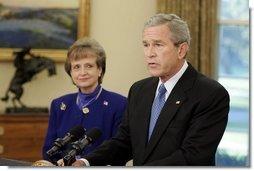
Disloyal, Elitist, Snobbish, Ultra-Conservative, Destroyer of the GOP

I am so over Harriet Miers. I feel like the New York traffic cop: “Move on. Nothing to see here.”

Over at the NY Times today, Hugh Hewitt wrote “Why the Right Was Wrong,” indicating that “the Harriet Miers precedent cements an extraconstitutional new standard for nominees.”

Aw c’mon, Hugh. Let’s cut to the chase. I am a conservative first and foremost. I have certain views and beliefs that I am not willing to compromise; not for party, not for man or woman. George Bush is a nice guy I’m sure, but he’s less and less impressing me as a Republican. GWB is leaving in three years; Miers would have been in the Supreme Court for the rest of her life.

As a strategist, you couldn’t see that the Dems would demand internal White House papers written by Miers?

And as a conservative, I am approaching threshold for being demonized as disloyal, an elitist, snobbish, ultra-conservative (meant to be a pejorative) and a demolisher of the GOP. Jeez; just take a big drink of Get Over It. I am not responsible for the poor planning of an administration. I am not responsible for Miers pulling her name because I happen to have an opinion.

Who knows where this will go? Who knows what name Bush will submit next? I certainly don’t. But I know one thing: I reserve the right to disagree AGAIN if I believe the choice isn’t the best for the SCOTUS.

Miers Withdraws Herself From SCOTUS Candidacy


Well, it only took four tries via Blogger, but I finally got in — I suspect other thousands of bloggers were attempting the same thing: access for comment.

Harriet Miers has now officially withdrawn her name as a candidate for the US Supreme Court. Sorry Hugh. From the AP:

President Bush said he reluctantly accepted her decision to withdraw, after weeks of insisting that he did not want her to step down. He blamed her withdrawal on calls in the Senate for the release of internal White House documents that the administration has insisted were protected by executive
privilege.

The Blogosphere and various hundreds of pundits and political commentators will now speculate about the credibility of the Bush Administration, the future of the GOP, blah blah blah. “We’re plummeting down in flames,” some R-Wing wonks will wail. There will be much breast beating and self-flagellation. Bleeding for the sake of blood. This afternoon Hugh Hewitt will rail, bemoan, point fingers and say “We didn’t even hear from her!” All true; we didn’t.

Now, Mr. President. NOW is the time to suck it up, take a big breath, gird thy loins and put up your dukes. You’ve got three more years, Mr. President. What you do now will most DEFINITELY define those remaining years.

I predicted this outcome in my 10-13 post and posited that Mr. Bush should create a new Short List of nominees to the SCOTUS.

I repeat myself at the risk of being a member of the Department of Redundancy Department: Mr. Bush, you have been given a huge opportunity: the chance to appoint three members to the US Supreme Court. This an incredible, historic opportunity. You will potentially affect a full one-third of the court.

Go for a strict constitutional constructionist. A legal SCC scholar. A Brown. A Luttig. A McConnell. Take the fight right back to the L-Wing. Make calls. Lean on people. Go public. Communicate. Ask for help. Rally your GOP. But FIGHT. Make a STAND. Do NOT appease; the time for conciliation is OVER.

Earth to President Bush: you were delivered a message from your supporters. Did you receive it? In my opinion, Miers did what was right. Can you, sir?

President For A Day


This post will be all about the results in the comment section, and I anticipate them eagerly.

The Scenario:
You are now President of the United States, George W. Bush. It is Thursday, 10-27-2005. Current events are precisely as they appear today.

The Challenge:
List the top five line items that you would address, by priority, to repair whatever damage you may perceive has been inflicted to the Bush Presidency.

If you believe the President is on track, list five other issues or areas that you think should be addressed during the remainder of the Bush term.

Be professional, be positive. This is not an exercise in complaints but an exercise in solutions. It is easy to complain; it is much more difficult to provide viable and innovative answers to global and national issues.

The ball is now in your court, and the White House is now in your hands. Go.

A Heaping Helping of Class: Good Comes From Bad


On Saturday, October 22nd, Modesto, California resident Diane Chandler discovered the Marine flag hung outside the Chandler home, to honor her son in Iraq, had disappeared. She was very angry. Who would steal a USMC flag from the very front of an American’s home? How low can you sink? From the Modesto Bee:

Tuesday, she found the Marine Corps flag she had hung to honor her son Jeff, who is serving near Baghdad, Iraq. The banner had been missing since Saturday morning.

But Chandler no longer wants the flag back. She wants it to stay right where it is: Decorating the grave of Marine Cpl. Michael D. Anderson Jr., who was killed in action in Iraq last year.

Michael D. Anderson Sr. and his wife, Angela, discovered the flag on Michael Jr.’s grave Sunday at Lakewood Memorial Park in Hughson.

“We put fresh flowers on Michael’s grave every week,” Anderson said. “We just thought it was a nice touch.”

The 11-inch-by-14-inch flag rests in front of the Anderson headstone. Two potted flowers, a surfer Bratz doll and replica dog tags rest on top of the marker.

Chandler, the Andersons and a Marine comrade of Mike Jr.’s, Terry Van Doorn, gathered at the grave Tuesday afternoon and marveled about the coincidences that brought them together.

Angela Anderson had taken The Bee to work Tuesday and saved it to read on her morning break. A story about a Marine mother caught her attention. “I called my husband and told him I thought the flag on Michael’s grave was the one in the story that (Diane) was looking for.”

Anderson agreed but could not find Chandler’s name in the phone book. So his wife hopped in her car and drove down Bowen Avenue looking for the makeshift sign that was shown in the newspaper. It closed with a “Shame on You!” exclamation.

She found the home and knocked on the door. She explained why she was there, and Chandler invited her in.

Angela Anderson’s description was a match for Chandler’s missing flag.

Tuesday, at young Anderson’s grave, Chandler said she’ll never move the flag. “It’s right where it belongs, honoring a Marine.”

Michael Anderson Sr. isn’t sure who brought the flag to stand beside his son’s grave. He does know how he’d feel if someone had stolen any of his Marine keepsakes: “It would be just awful. I’d be out there with my rifles trying to hunt the dogs down.”

The Andersons had every intention of returning the flag, but Chandler won’t consider it. Angela Anderson, looking at the grave, said, “Good can come from something bad.”

The Andersons are unofficially adopting Jeff Chandler and are preparing to mail him care packages in Iraq.

“I know what the boys over there need and want,” Michael Anderson said.

The worst Chandler will say now about the culprit who copped her Marine banner is that it was “a misguided patriot. If they would have asked, I would have given it to them.”

In Chandler’s long view, she didn’t lose a flag. She gained some lifetime friends.

There are right things are there are wrong things. There are times to consider the greater good. Diane Chandler did the right thing. And as a result ended up honoring a fallen Marine, honoring her son and the family name, and embracing another Marine family for life.

With all else occurring in the world, it is good to read about heartening things. God Bless America.

Turning the Internet Over to Our Good Friends At the United Nations


I recently made a comment over on Revka’s Take (go take a peek right now!) and happened to mention the internet and its possible subsequent control by the United Nations — which made me want to discuss the issue here and now.

You realize, of course, there is a push to wrest “control” of the internet from the United States and turn same over to the United Nations, don’t you? Once again, it is a matter of the evil, acerbic, judgmental, uncultured US holding domain over a technology that clearly should fall under the loving, understanding and compassionate umbrella of the wise, efficient and uncorruptible United Nations. This is a long quote, from Britain’s The Guardian, but worth reading:

Breaking America’s grip on the net; after troubled negotiations in Geneva, the US may be forced to relinquish control of the internet to a coalition of governments (Thursday October 6, 2005).

The issue of who should control the net had proved an extremely divisive issue, and for 11 days the world’s governments traded blows. For the vast majority of people who use the internet, the only real concern is getting on it. But with the internet now essential to countries’ basic infrastructure – Brazil relies on it for 90% of its tax collection – the question of who has control has become critical.

And the unwelcome answer for many is that it is the US government. In the early days, an enlightened Department of Commerce (DoC) pushed and funded expansion of the internet. And when it became global, it created a private company, the Internet Corporation for Assigned Names and Numbers (ICANN) to run it.

But the DoC retained overall control, and in June stated what many had always feared: that it would retain indefinite control of the internet’s foundation – its “root servers”, which act as the basic directory for the whole internet.

A number of countries represented in Geneva, including Brazil, China, Cuba, Iran and several African states, insisted the US give up control, but it refused. The meeting “was going nowhere”, Hendon says, and so the EU took a bold step and proposed two stark changes: a new forum that would decide public policy, and a “cooperation model” comprising governments that would be in overall charge.

Much to the distress of the US, the idea proved popular. Its representative hit back, stating that it “can’t in any way allow any changes” that went against the “historic role” of the US in controlling the top level of the internet.

But the refusal to budge only strengthened opposition, and now the world’s governments are expected to agree a deal to award themselves ultimate control. It will be officially raised at a UN summit of world leaders next month and, faced with international consensus, there is little the US government can do but acquiesce.

I would submit that this should never be done. Never. Ever. It’s the oldest story in politics and bureucracies: take from the producers (the US essentially invented the internet by way of our military ARPANET) and distribute to the non-producers (what has the world done besides prosper and change as the result of this incredible invention and philosophy of the total freedom of information?).

As an aside here: one LARGE reason I like the internet? It is an incredible playing-field “leveler.” That is to say, my website can be every bit as attractive (if I had the technological capability) as that of, say, the mega-corporate GM website. It’s all ones and zeroes.

The Christian Science Monitor nails it on the head when it writes:

The free flow of ideas and commerce, so key to the Internet’s exponential growth, would not be well served if hobbled by bureaucracy or chilled by governments interested in suppressing dissident voices.

It continues:

If international demands for less US control boil over, other countries could employ a “nuclear option” – setting up a rival to ICANN and potentially creating chaos on the Internet with two divergent standards.

That need not happen. International governance of the Internet does have an inescapable logic. Better that the US engage vigorously now in shaping that institution, even as it realizes that handing off control to it is nowhere in the immediate future.

Why does the world see this as simply another example of arrogant US unilateralism? Hiawatha Bray at The Boston Globe responds:

To understand why, you need only consider that the international talks over the future of the root server network, to be held next month in Tunisia, are sponsored by the United Nations. That’s right — there’s a plan afoot to put critical Internet infrastructure under the control of the UN — the same outfit that has given us the Iraq oil-for-food scandal and a child prostitution ring in Congo. It’s hard to see why an agency so steeped in corruption should be given oversight of the computers that serve as the Internet’s chief traffic cops.

My point, as a conservative, primarily revolves around money and, more importantly: taxes. What will a controlling UN authority do with the massive tax potential of something as far-reaching as the internet? The Globe continues:

Then there’s the prospect of an international Internet tax, with money going to fund technology development in developing countries. The UN has been pushing this idea since 1999. A UN-controlled ICANN might dramatically jack up the cost of Internet addresses in affluent countries like the United States to raise money for its development fund. And Americans would have little say over how this money is spent.

Okay, so we don’t hand control of the internet to the UN? What’s the downside? Some Bush administration critics say that a refusal to turn over control will cause other countries to set up their own separate versions of the internet, in essence making two separate nets. So what? Who really cares? “If it doesn’t connect to the ”real” Internet, it’s useless. If it does connect to the ”real” Internet, who cares?”

At least the Bush Administration is making an overt attempt to keep control in the US, as it is backing Senator Norm Coleman’s (R, Minnesota) resolution to support ICANN. Coleman said “The Internet is likely to face a grave threat” at the Tunisian World Summit. “If we fail to respond appropriately, we risk the freedom and enterprise fostered by this informational marvel and end up sacrificing access to information, privacy and protection of intellectual property we have all depended on.” Luckily, support appears to be bipartisan as similar support has already come from both senior Democrats and Republicans in the U.S. House of Representatives.

Human rights issues. Taxation issues. Oversight and final control issues. I tend to be proprietary; but let’s put the shoe on the other foot. What if the internet were “invented” and first placed into usage by scientists and the military minds of France. And let’s say the US and Canada decided we wanted to wrest control and place it under our collective monitoring and final authority.

What would the rest of the world say about that decision?

Bottom line? No matter what the US does, it will likely be despised on any number of levels for any number of real (and primarily imagined) slights. We should, therefore, keep doing what we’re doing — to the continued benefit of all persons hooked online, no matter the country, ethnicity or religion.