Air America: Striving to Be Above Pathetic


But not quite making it. Witnesseth:

If Al Franken speaks on the radio, and no one is tuned in to hear him, does he make a sound? And what would it be? — the sound of money and coke flushed down a toilet? Getting a little jowly these days, Al? Age catching up with the disappointment, sir?

That could be the question being asked these days in the nation’s capital, where Franken’s liberal network, Air America, has no measurable audience according to the Arbitron rating service.

It only gets better:

The Washington Post reports the dismal ratings are in for the summer seasonal ARB “book”:

Air America, the liberal talk network carried on WWRC-AM (1260), went from bad to nonexistent. After WWRC recorded a mere fraction of a rating point in the spring with syndicated shows from the likes of lefty talkers Al Franken, Janeane Garofalo and Stephanie Miller, Arbitron couldn’t detect a measurable listenership for the station this time around. Notes Chris Field of the conservative publication Human Events, “Static would fare about as well.”

And static most definitely describes Air America.

From the “And You Thought I Was Harsh On Bush” Department:


Whilst perusing the internet once again, sifting through the legion of “1s” and “0s”, I found the following article from the Wall Street Journal — occasionally a bastion of right-thinking editorial philosophies. In this piece, Robert Bork (he of the “Borked” origin) writes about the nomination by President Bush of Harriet E. Miers to the US Supreme Court.

Now, consider that many persons on the right side of the aisle have taken Mr. Bush to task for this nomination — most prominently the National Review and the Weekly Standard — both right wing bastions; and myself as well (see my Tuesday, 10-18-05 post). In retrospect, I have nothing on Mr. Bork when he writes, in his very first paragraph from the article:

With a single stroke–the nomination of Harriet Miers–the president has damaged the prospects for reform of a left-leaning and imperialistic Supreme Court, taken the heart out of a rising generation of constitutional scholars, and widened the fissures within the conservative movement. That’s not a bad day’s work–for liberals.

Eeee-yow! Not bad — if you’re Vlad the Impaler. Instead of pulling the pike through the wound, Bork may as well pull it back out the way it came:

There is, to say the least, a heavy presumption that Ms. Miers, though undoubtedly possessed of many sterling qualities, is not qualified to be on the Supreme Court. It is not just that she has no known experience with constitutional law and no known opinions on judicial philosophy. It is worse than that. As president of the Texas Bar Association, she wrote columns for the association’s journal. David Brooks of the New York Times examined those columns. He reports, with supporting examples, that the quality of her thought and writing demonstrates absolutely no “ability to write clearly and argue incisively.”

Holy crap. As a child I used to salt snails and take a magnifying glass to slugs — but I outgrew that. Bork continues:

By passing over the many clearly qualified persons, male and female, to pick a stealth candidate, George W. Bush has sent a message to aspiring young originalists that it is better not to say anything remotely controversial, a sort of “Don’t ask, don’t tell” admonition to would-be judges. It is a blow in particular to the Federalist Society, most of whose members endorse originalism. The society, unlike the ACLU, takes no public positions, engages in no litigation, and includes people of differing views in its programs. It performs the invaluable function of making law students, in the heavily left-leaning schools, aware that there are respectable perspectives on law other than liberal activism. Yet the society has been defamed in McCarthyite fashion by liberals; and it appears to have been important to the White House that neither the new chief justice nor Ms. Miers had much to do with the Federalists.

In many ways President Bush is like most conservatives; in some very unsettling ways he is like many Democrats. I fear that some of his recent conciliatory moves (new immigration reform emphasis) are too little, too late — and is posturing at best. When he stands to place more Border Patrol agents on our southern lines (and the Federal Law Enforcement Training Center in Glynco, GA can only kick out 1,500 per year), he leaves totally unaddressed the issue of federal court judges sufficient to hear the number of immigration cases that would come before that bench. As one Border Patrol agent said: “We can make all the arrests we want; they’ll just get kicked because we can’t hear them and handle them.”

Heavy sigh.

From My Neck of the Woods: Body of WWII Airman Found In Glacier


FRESNO, Calif. – A glacier-encased body believed to be a World War II airman who crashed into the Sierra Nevada in 1942 was flown off the mountain and into a Fresno laboratory for identification, the county’s deputy coroner said Thursday.

Blustery conditions kept rangers at Kings Canyon National Park from reaching the frozen remains for two days after two ice climbers reported last weekend they had seen a man’s head, shoulder and arm protruding from the thick ice. About 80 percent of the body was buried in the glacier on the side of the 13,710-foot Mount Mendel.

The remote wilderness area can only be reached by hiking two or three days, or by helicopter when the weather allows, rangers said.

Six park rangers and a military forensics expert started chipping away at the ice on Wednesday, freeing the body after about six hours of meticulous work, said ranger Alexandra Picavet.

“The body barely got out before dark hit,” said Picavet, explaining the experts were able to free the body faster than she expected. “The ice initially wasn’t bad to dig through, but then as they got deeper it became more difficult.”

The crew had to be careful not to damage the remains, and that made the work slow because they didn’t know how the body was positioned, Picavet said.

The remains were then flown to the Fresno County Coroner’s department.

Deputy Coroner Robert Glasbie said local experts are planning to work with officials from the Joint Prisoner of War Accounting Command, which recovers and identifies missing military personnel. The team will include a forensic anthropologist and a pathologist, who will determine the body’s state, Glasbie said.

Park officials summoned the military agency because the man was still wearing a parachute with the word “Army” stenciled onto it. They believe the serviceman may be part of the crew of an AT-7 navigational training plane that crashed on the mountain on Nov. 18, 1942. Several military planes crashed among the craggy peaks in the 1930s and 1940s, and many are still missing.

The wreckage was initially spotted by a climber in 1947. It’s impossible to tell if this body is really connected to that expedition until experts go through the identification process, which will include a thorough examination of the clothing and a search for any documents that may have survived the decades, and may include dental records, X-rays or DNA testing, experts said.

Experts said the body was probably not seen for decades because the desolate landscape doesn’t attract many casual visitors, through it is popular with ice climbers. The finding surprised Michael Nozel, one of the climbers who first located the body on Sunday.

“It was quite a windy day and I could see the fluttering of the parachute and that was the first thing that kind of caught my eye,” Nozel told KFSN, a local ABC television affiliate. “As I got closer, I started to think, gosh, that doesn’t look like a rock sticking out of the glacier. And I thought at first … no, even though it does look like a body, I don’t think that’s what it is. And then of course, as I got closer, I thought, my goodness I think that is a body.”

Military officials said there are 88,000 Americans still missing from past wars, most of them, 78,000, from World War II. Only about 35,000 are deemed recoverable.

Officials with JPAC said they have located and identified remains found in glaciers before. The last one was a Cold War-era serviceman found in Greenland.

Bob Mann, the deputy scientific director with the command’s Central Identification Laboratory, said sometimes remains found in glaciers are reasonably well preserved. Often even soft tissue like skin can keep well in icy conditions.

Glaciers are living things, Mann said, slowly melting around the edges and grinding over rock as they move, and sometimes leaving behind long-hidden secrets like this one.

The agency processes hundreds of cases a year, and has an average of two identifications a week, said spokeswoman Rumi Nielson-Green.

“To those families, those are the ones that count,” she said.

My father, who is 85, recently told me of an airman who crashed into a mountain during training in World War II.

I wonder. . .I think I’ll give my dad a call.

The Docs Are Wrong: Trust Me, I’m Spanish


Agricultural Minister Elena Espinosa of Spain, during a radio broadcast on Cadena Ser (attributed to Agence France-Presse), said the H5N1 strain of the avia flu is “solely and exclusively a veterinary problem.”

Espinosa said “The idea of a pandemic among humans is something from science fiction.” Further, she said human infections currently in Asia were “in very specific poultry raising situations where the families lived with the chickens and infection was due to constant inhalation.”

Is this not the nation that, following the Al Queda attack on March 12, 2004, elected an administration that folded its tent in Iraq and assumed the fetal position when confronted by terrorists? I suppose that’s a nice way of saying I’m “considering the source.”

In the real world, the strain of H5N1 has been documented and specifically linked to the deaths of 60 persons in Asia in the past three years. Scientists say that, though the strain does not yet spread easily from person to person, the possibility exists that it could mutate into a variety that could be spread as easily as any seasonal flu.

CDC Director Julie Gerberding said “If ever there was a time when the risk (of a pandemic) was higher than usual, it is now.”

World Health Organization Regional Director for the Western Pacific, Shigeru Omi, said that with one small genetic adjustment in Influenza A, or H5N1, millions of people across the planet could die on a scale of the 1918 flu pandemic. Public health officials from the Western Pacific region recently gathered at Noumea, New Caledonia, on September 19th, to discuss the issue.

The worst-case scenario, the New York Times reported, would be if person-to-person transmission spawned successive generations of severe disease with high mortality – the situation during the great influenza pandemic of 1918-1919, which killed an estimated 40 to 50 million people.

The early 20th century disaster resulted from the emergence of a completely new influenza virus subtype that spread worldwide in four to six months, causing several waves of infection over two years.

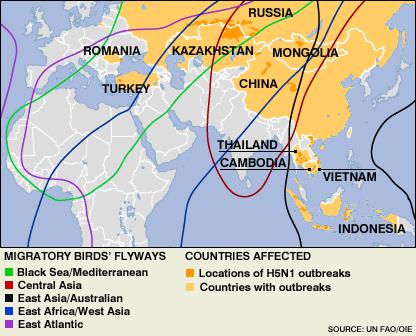
The H5N1 virus, which spreads through migratory birds, has plagued poultry populations in Asia since 2003, exposing more humans.

Several nations in Europe and Asia are now reporting new cases of the lethal H5N1 bird flu strain among poultry, sparking new fears that humans could be at risk. Fresh outbreaks have been reported in Romania and Russia. China says it has lost thousands of fowl to the virus.

More on this in later posts.

Timing In the Immigration Issue — And What About H5N1?


The New York Times and Associated Press reported yesterday:

President Bush vowed on Tuesday to get tough on illegal immigrants even as he urged Congress to adopt a temporary-worker program that would allow some to remain in the United States for as long as six years.

“We’re going to get control of our borders,” Mr. Bush said in the White House East Room just before signing a $32 billion domestic security bill that has big increases for the Border Patrol, including money for 1,000 new agents and improved technology. “We’ll make this country safer for all our citizens.”

Homeland Security Secretary Michael Chertoff said his department aims without exception to expel all those who enter the United States illegally. “Our goal at DHS (Homeland Security) is to completely eliminate the ‘catch and release’ enforcement problem, and return every single illegal entrant, no exceptions.

“It should be possible to achieve significant and measurable progress to this end in less than a year,” Chertoff told a Senate hearing.

Thousands of “Mexicans who are caught entering the United States illegally are returned immediately to Mexico. But other parts of the system have nearly collapsed under the weight of numbers. The problem is especially severe for non-Mexicans apprehended at the southwest border,” Chertoff explained.

“Today, a non-Mexican illegal immigrant caught trying to enter the United States across the southwest border has an 80 percent chance of being released immediately because we lack the holding facilities,” he added.

“Through a comprehensive approach, we are moving to end this ‘catch and release’ style of border enforcement by reengineering our detention and removal process.” Chertoff’s remarks in favor of returning “every illegal entrant, no exceptions” appeared to conflict directly with the US policy toward illegal Cuban migrants.

Though Cubans picked up at sea are returned to their country, those who reach US soil by air, sea or ground are allowed to stay and work — a fact Cuba says encourages dangerous illegal emigration attempts. Mr. Bush added, “If somebody is here illegally, we’ve got to do everything we can to find them.” Once illegal immigrants are caught, he said, they must be “returned to their home countries as soon as possible.”

Mr. Bush’s words, among his most insistent on illegal immigrants to date, were intended to calm conservatives upset at his temporary-worker plan, which a number of Republicans view as an amnesty program. Mr. Bush first proposed the plan in January 2004, but it has run into resistance.

In a renewed effort to win support, the White House is now emphasizing the border enforcement part of the plan, but at the same time insisting that enforcement can work only as a part of what Mr. Bush on Tuesday called “a larger, comprehensive immigration reform program.”

The timing of this re-focus on immigration issues by the Bush Administration coincides with the overall noise in the blogosphere (myself included) and other fronts (National Review) about the Harriet Miers nomination, and appears to be something of a conciliatory measure to reassure the more conservative base that the president has not abandoned his core.

I have no problem with a temporary worker program; it can be changed and amended when desired. Physically, there is no way to “expel” all those illegal aliens present in the country. The holding facilities and courts sufficient to handle the numbers simply don’t exist. Vetting each person entering the country from this point out (or doing our best to do so) and buttressing our borders is a step in the right direction.

In addition, the avian H5N1 flu will impact how we conduct our immigration business as well. It’s not a matter of if but when the bird flu arrives in the US, and when it converts from the avian population to the human population. LAX, which moves 10,000 persons a day, is already making plans to take 1,600 passengers at a time and move them to detention centers for a 4 to 10 day flu quarantine.

More on the avian flu issue later — the potential hazard here is staggering — perhaps not unlike the 1918 flu pandemic.